
當(dāng)可變形注意力機(jī)制引入Vision Transformer

極市導(dǎo)讀
?通過在Transformer基礎(chǔ)上引入Deformable CNN中的可變性能力,在降低模型參數(shù)量的同時(shí)提升獲取大感受野的能力,文內(nèi)附代碼解讀。?>>加入極市CV技術(shù)交流群,走在計(jì)算機(jī)視覺的最前沿
引言
Transformer由于其更大的感受野能夠讓其擁有更強(qiáng)的模型表征能力,性能上超越了很多CNN的模型。
然而單純增大感受野也會帶來其他問題,比如說ViT中大量使用密集的注意力,會導(dǎo)致需要額外的內(nèi)存和計(jì)算代價(jià),特征很容易被無關(guān)的部分所影響。
而PVT或者Swin Transformer中使用的sparse attention是數(shù)據(jù)不可知的,會影響模型對長距離依賴的建模能力。
由此引入主角:Deformabel Attention Transformer的兩個(gè)特點(diǎn):
data-dependent: key和value對的位置上是依賴于數(shù)據(jù)的。 結(jié)合Deformable 方式能夠有效降低計(jì)算代價(jià),提升計(jì)算效率。
下圖展示了motivation:
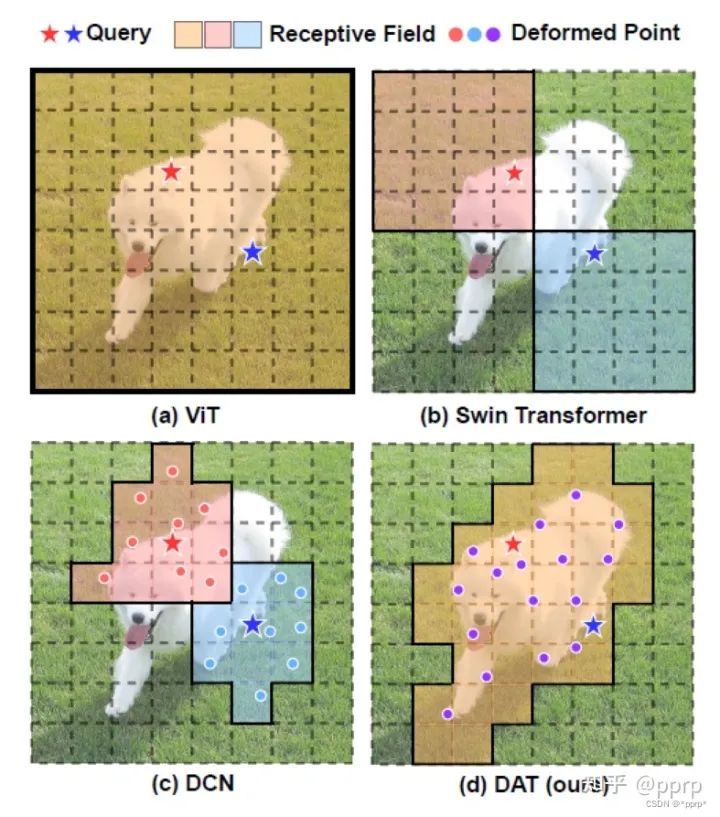
圖中比較了幾種方法的感受野,其中紅色星星和藍(lán)色星星表示的是不同的query。而實(shí)線包裹起來的目標(biāo)則是對應(yīng)的query參與處理的區(qū)域。
(a) ViT對所有的query都一樣,由于使用的是全局的注意力,所以感受野覆蓋全圖。
(b) Swin Transformer中則使用了基于window劃分的注意力。不同query處理的位置是在一個(gè)window內(nèi)部完成的。
(c) DCN使用的是3x3卷積核基礎(chǔ)上增加一個(gè)偏移量,9個(gè)位置都學(xué)習(xí)到偏差。
(d) DAT是本文提出的方法,由于結(jié)合ViT和DCN,所有query的響應(yīng)區(qū)域是相同的,但同時(shí)這些區(qū)域也學(xué)習(xí)了偏移量。
方法
先回憶一下Deformable Convolution:

簡單來講是使用了額外的一個(gè)分支回歸offset,然后將其加載到坐標(biāo)之上得到合適的目標(biāo)。
在回憶一下ViT中的Multi-head Self-attention:
有了以上鋪墊,下圖就是本文最核心的模塊Deformable Attention。
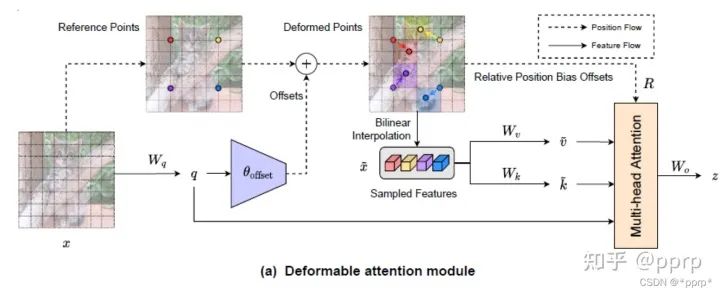
左邊這部分使用一組均勻分布在feature map上的參照點(diǎn) 然后通過offset network學(xué)習(xí)偏置的值,將offset施加于參照點(diǎn)中。 在得到參照點(diǎn)以后使用bilinear pooling操作將很小一部分特征圖摳出來,作為k和v的輸入
x_sampled = F.grid_sample(
input=x.reshape(B * self.n_groups, self.n_group_channels, H, W),
grid=pos[..., (1, 0)], # y, x -> x, y
mode='bilinear', align_corners=True) # B * g, Cg, Hg, Wg
之后將得到的Q,K,V執(zhí)行普通的self-attention, 并在其基礎(chǔ)上增加relative position bias offsets。
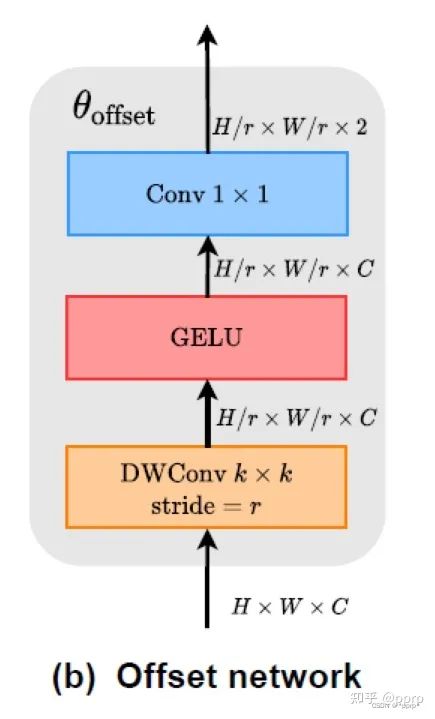
其中offset network構(gòu)建很簡單, 代碼和圖示如下:
  self.conv_offset = nn.Sequential(
      nn.Conv2d(self.n_group_channels, self.n_group_channels, kk, stride, kk//2, groups=self.n_group_channels),
      LayerNormProxy(self.n_group_channels),
      nn.GELU(),
      nn.Conv2d(self.n_group_channels, 2, 1, 1, 0, bias=False)
  )
最終網(wǎng)絡(luò)結(jié)構(gòu)為:
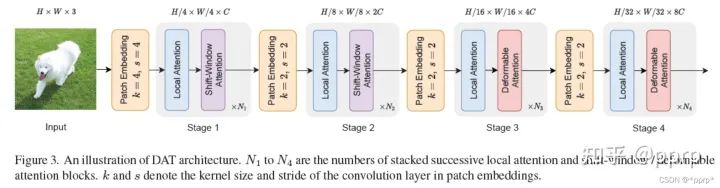
具體參數(shù)如下:
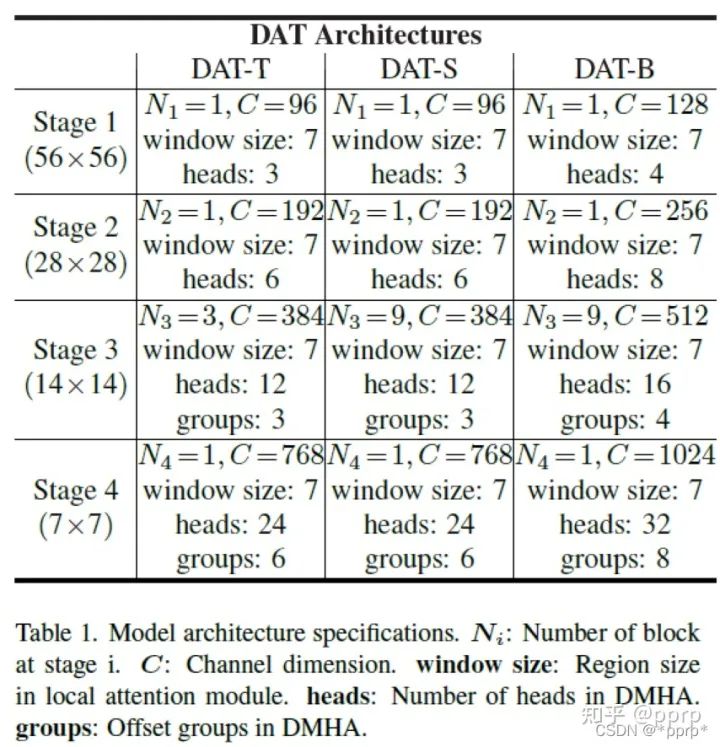
實(shí)驗(yàn)
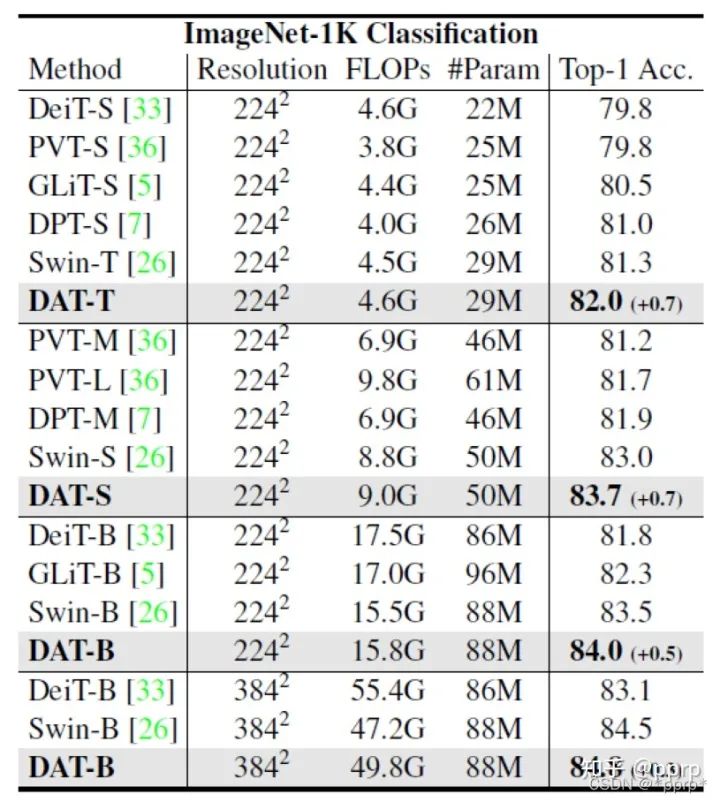
實(shí)驗(yàn)配置:300epoch,batch size 1024, lr=1e-3,數(shù)據(jù)增強(qiáng)大部分follow DEIT
分類結(jié)果:
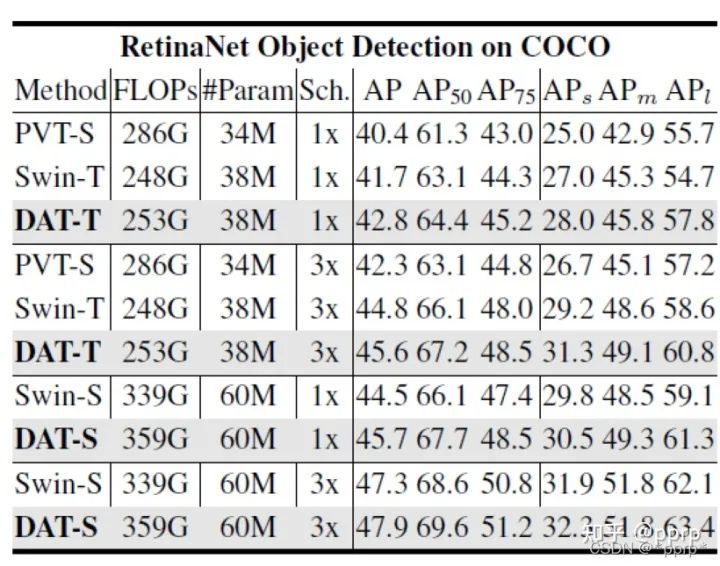
目標(biāo)檢測數(shù)據(jù)集結(jié)果:
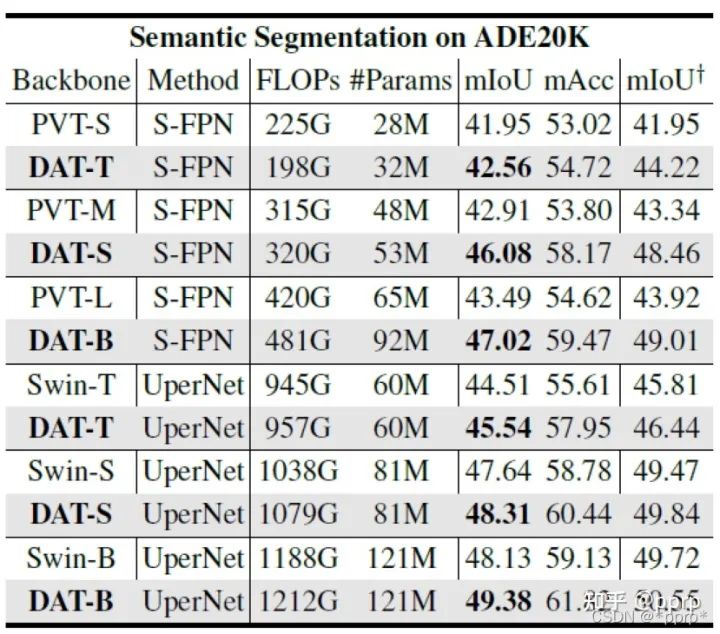
語義分割:
消融實(shí)驗(yàn):

可視化結(jié)果:COCO

這個(gè)可視化結(jié)果有點(diǎn)意思,如果是分布在背景上的點(diǎn)大部分變動不是很大,即offset不是很明顯,但是目標(biāo)附近的點(diǎn)會存在一定的集中趨勢(ps:這種趨勢沒有Deformable Conv中的可視化結(jié)果明顯)
代碼
生成Q
  B, C, H, W = x.size()
  dtype, device = x.dtype, x.device

  q = self.proj_q(x)
offset network前向傳播得到offset
  q_off = einops.rearrange(q, 'b (g c) h w -> (b g) c h w', g=self.n_groups, c=self.n_group_channels)
  offset = self.conv_offset(q_off) # B * g 2 Hg Wg
  Hk, Wk = offset.size(2), offset.size(3)
  n_sample = Hk * Wk
在參照點(diǎn)基礎(chǔ)上使用offset
offset = einops.rearrange(offset, 'b p h w -> b h w p')
reference = self._get_ref_points(Hk, Wk, B, dtype, device)

if self.no_off:
    offset = offset.fill(0.0)

if self.offset_range_factor >= 0:
    pos = offset + reference
else:
    pos = (offset + reference).tanh()
使用bilinear pooling的方式將對應(yīng)feature map摳出來,等待作為k,v的輸入。
x_sampled = F.grid_sample(
    input=x.reshape(B * self.n_groups, self.n_group_channels, H, W),
    grid=pos[..., (1, 0)], # y, x -> x, y
    mode='bilinear', align_corners=True) # B * g, Cg, Hg, Wg

x_sampled = x_sampled.reshape(B, C, 1, n_sample)

q = q.reshape(B * self.n_heads, self.n_head_channels, H * W)
k = self.proj_k(x_sampled).reshape(B * self.n_heads, self.n_head_channels, n_sample)
v = self.proj_v(x_sampled).reshape(B * self.n_heads, self.n_head_channels, n_sample)
在positional encodding部分引入相對位置的偏置:
  rpe_table = self.rpe_table
  rpe_bias = rpe_table[None, ...].expand(B, -1, -1, -1)

  q_grid = self._get_ref_points(H, W, B, dtype, device)

  displacement = (q_grid.reshape(B * self.n_groups, H * W, 2).unsqueeze(2) - pos.reshape(B * self.n_groups, n_sample, 2).unsqueeze(1)).mul(0.5)

  attn_bias = F.grid_sample(
      input=rpe_bias.reshape(B * self.n_groups, self.n_group_heads, 2 * H - 1, 2 * W - 1),
      grid=displacement[..., (1, 0)],
      mode='bilinear', align_corners=True
  ) # B * g, h_g, HW, Ns

  attn_bias = attn_bias.reshape(B * self.n_heads, H * W, n_sample)

  attn = attn + attn_bias
參考
https://github.com/LeapLabTHU/DAT
https://arxiv.org/pdf/2201.00520.pdf
如果覺得有用,就請分享到朋友圈吧!
公眾號后臺回復(fù)“transformer”獲取最新Transformer綜述論文下載~

#?CV技術(shù)社群邀請函?#

備注:姓名-學(xué)校/公司-研究方向-城市(如:小極-北大-目標(biāo)檢測-深圳)
即可申請加入極市目標(biāo)檢測/圖像分割/工業(yè)檢測/人臉/醫(yī)學(xué)影像/3D/SLAM/自動駕駛/超分辨率/姿態(tài)估計(jì)/ReID/GAN/圖像增強(qiáng)/OCR/視頻理解等技術(shù)交流群
每月大咖直播分享、真實(shí)項(xiàng)目需求對接、求職內(nèi)推、算法競賽、干貨資訊匯總、與?10000+來自港科大、北大、清華、中科院、CMU、騰訊、百度等名校名企視覺開發(fā)者互動交流~
