
Flink SQL空閑狀態(tài)保留時(shí)間實(shí)現(xiàn)原理

前言
如果要列舉Flink SQL新手有可能犯的錯(cuò)誤,筆者認(rèn)為其中之一就是忘記設(shè)置空閑狀態(tài)保留時(shí)間導(dǎo)致狀態(tài)爆炸。
為什么要設(shè)置
如果我們?cè)跀?shù)據(jù)流上進(jìn)行分組查詢,分組處理產(chǎn)生的結(jié)果(不僅僅是聚合結(jié)果)會(huì)作為中間狀態(tài)存儲(chǔ)下來。隨著分組key的不斷增加,狀態(tài)自然也會(huì)不斷膨脹。但是這些狀態(tài)數(shù)據(jù)基本都有時(shí)效性,不必永久保留。例如,使用Top-N語法進(jìn)行去重,重復(fù)數(shù)據(jù)的出現(xiàn)一般都位于特定區(qū)間內(nèi)(例如一小時(shí)或一天內(nèi)),過了這段時(shí)間之后,對(duì)應(yīng)的狀態(tài)就不再需要了。Flink SQL提供的idle state retention time特性可以保證當(dāng)狀態(tài)中某個(gè)key對(duì)應(yīng)的數(shù)據(jù)未更新的時(shí)間達(dá)到閾值時(shí),該條狀態(tài)被自動(dòng)清理。設(shè)置方法是:
stenv.getConfig().setIdleStateRetentionTime(Time.hours(24), Time.hours(36))
注意setIdleStateRetentionTime()方法需要傳入兩個(gè)參數(shù):狀態(tài)的最小保留時(shí)間minRetentionTime和最大保留時(shí)間maxRetentionTime(根據(jù)實(shí)際業(yè)務(wù)決定),且兩者至少相差5分鐘。為什么會(huì)有這種限制呢?看一下源碼就知道了。
如何實(shí)現(xiàn)的
idle state retention time特性在底層以o.a.f.table.runtime.functions.CleanupState接口來表示,代碼如下。
public interface CleanupState {
    default void registerProcessingCleanupTimer(
            ValueState<Long> cleanupTimeState,
            long currentTime,
            long minRetentionTime,
            long maxRetentionTime,
            TimerService timerService)
            throws Exception {
        // last registered timer
        Long curCleanupTime = cleanupTimeState.value();

        // check if a cleanup timer is registered and
        // that the current cleanup timer won't delete state we need to keep
        if (curCleanupTime == null || (currentTime + minRetentionTime) > curCleanupTime) {
            // we need to register a new (later) timer
            long cleanupTime = currentTime + maxRetentionTime;
            // register timer and remember clean-up time
            timerService.registerProcessingTimeTimer(cleanupTime);
            // delete expired timer
            if (curCleanupTime != null) {
                timerService.deleteProcessingTimeTimer(curCleanupTime);
            }
            cleanupTimeState.update(cleanupTime);
        }
    }
}
由上可知,每個(gè)key對(duì)應(yīng)的最近狀態(tài)清理時(shí)間會(huì)單獨(dú)維護(hù)在ValueState中。如果滿足以下兩條件之一:
ValueState為空(即這個(gè)key是第一次出現(xiàn))
或者當(dāng)前時(shí)間加上minRetentionTime已經(jīng)超過了最近清理的時(shí)間
就用當(dāng)前時(shí)間加上maxRetentionTime注冊(cè)新的Timer,并將其時(shí)間戳存入ValueState,用于觸發(fā)下一次清理。如果有已經(jīng)過期了的Timer,則一并刪除之。可見,如果minRetentionTime和maxRetentionTime的間隔設(shè)置太小,就會(huì)比較頻繁地產(chǎn)生Timer與更新ValueState,維護(hù)Timer的成本會(huì)變大(參見之前筆者寫的Timer原理文章),所以一般建議設(shè)置間隔比較長(zhǎng)的清理區(qū)間。
CleanupState接口的繼承關(guān)系如下圖所示。
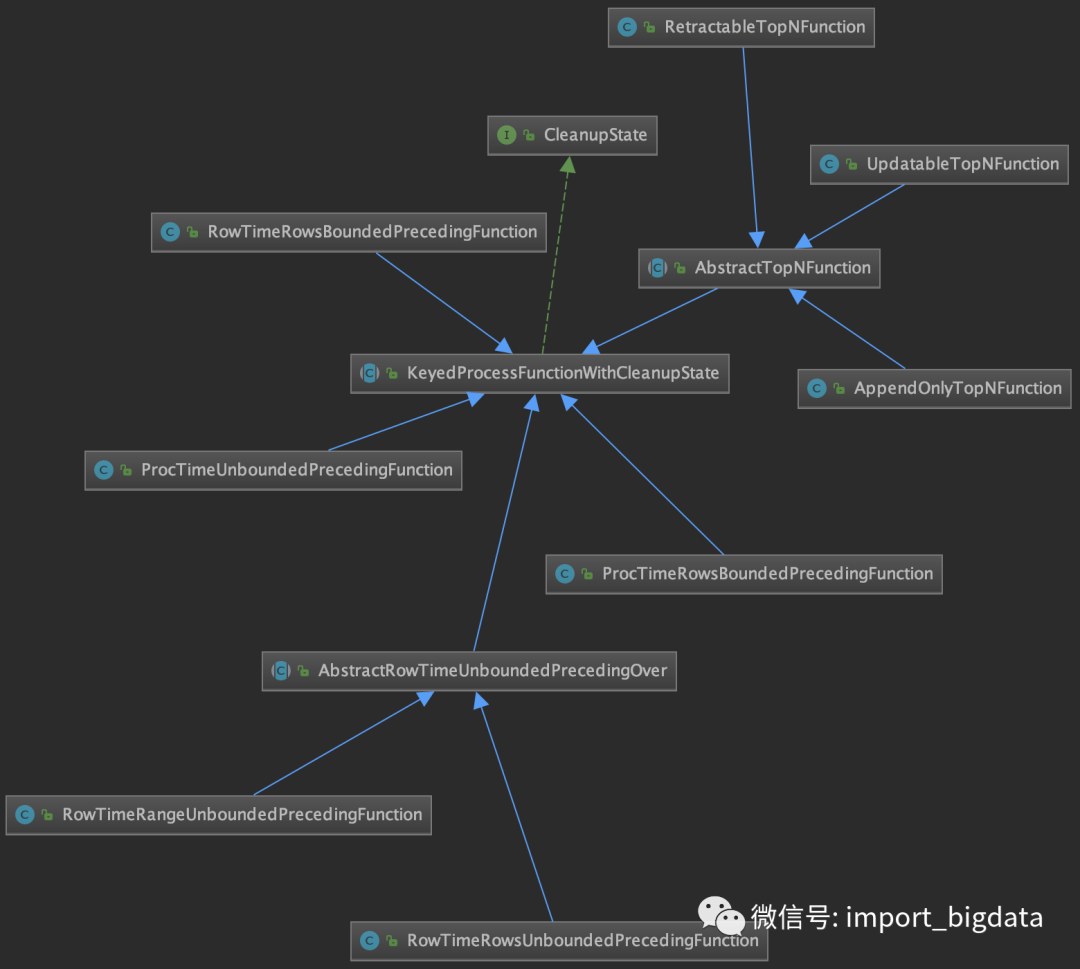
可見支持空閑狀態(tài)清理的Function很多,但基類都是KeyedProcessFunctionWithCleanupState抽象類。它的源碼如下。
public abstract class KeyedProcessFunctionWithCleanupState<K, IN, OUT>
        extends KeyedProcessFunction<K, IN, OUT> implements CleanupState {
    private static final long serialVersionUID = 2084560869233898457L;

    private final long minRetentionTime;
    private final long maxRetentionTime;
    protected final boolean stateCleaningEnabled;

    // holds the latest registered cleanup timer
    private ValueState<Long> cleanupTimeState;

    public KeyedProcessFunctionWithCleanupState(long minRetentionTime, long maxRetentionTime) {
        this.minRetentionTime = minRetentionTime;
        this.maxRetentionTime = maxRetentionTime;
        this.stateCleaningEnabled = minRetentionTime > 1;
    }

    protected void initCleanupTimeState(String stateName) {
        if (stateCleaningEnabled) {
            ValueStateDescriptor<Long> inputCntDescriptor =
                    new ValueStateDescriptor<>(stateName, Types.LONG);
            cleanupTimeState = getRuntimeContext().getState(inputCntDescriptor);
        }
    }

    protected void registerProcessingCleanupTimer(Context ctx, long currentTime) throws Exception {
        if (stateCleaningEnabled) {
            registerProcessingCleanupTimer(
                    cleanupTimeState,
                    currentTime,
                    minRetentionTime,
                    maxRetentionTime,
                    ctx.timerService());
        }
    }

    protected boolean isProcessingTimeTimer(OnTimerContext ctx) {
        return ctx.timeDomain() == TimeDomain.PROCESSING_TIME;
    }

    protected void cleanupState(State... states) {
        for (State state : states) {
            state.clear();
        }
        this.cleanupTimeState.clear();
    }

    protected Boolean needToCleanupState(Long timestamp) throws IOException {
        if (stateCleaningEnabled) {
            Long cleanupTime = cleanupTimeState.value();
            // check that the triggered timer is the last registered processing time timer.
            return timestamp.equals(cleanupTime);
        } else {
            return false;
        }
    }
}
可以發(fā)現(xiàn),空閑狀態(tài)保留時(shí)間目前仍然只支持processing time語義,并且minRetentionTime只有設(shè)為大于0的值才會(huì)生效。
KeyedProcessFunctionWithCleanupState只是提供了一些helper方法,具體發(fā)揮作用需要到實(shí)現(xiàn)類中去找。以計(jì)算Top-N的AppendOnlyTopNFunction為例,它的processElement()方法中會(huì)對(duì)到來的每個(gè)元素注冊(cè)清理Timer:
@Override
public void processElement(RowData input, Context context, Collector<RowData> out) throws Exception {
    long currentTime = context.timerService().currentProcessingTime();
    // register state-cleanup timer
    registerProcessingCleanupTimer(context, currentTime);
    // ......
}
而一旦Timer觸發(fā),在onTimer()方法中調(diào)用基類的cleanupState()方法來實(shí)際清理:
@Override
public void onTimer(
        long timestamp,
        OnTimerContext ctx,
        Collector<RowData> out) throws Exception {
    if (stateCleaningEnabled) {
        // cleanup cache
        kvSortedMap.remove(keyContext.getCurrentKey());
        cleanupState(dataState);
    }
}
空閑狀態(tài)保留的邏輯并不僅應(yīng)用在上述Function中。在Table/SQL模塊中還有一個(gè)內(nèi)置的觸發(fā)器StateCleaningCountTrigger,它可以對(duì)窗口中的元素進(jìn)行計(jì)數(shù),并按照計(jì)數(shù)閾值或者空閑狀態(tài)保留的時(shí)間閾值來清理(即FIRE_AND_PURGE)。看官可自行參考對(duì)應(yīng)的源碼。
