
你真的懂string與[]byte的轉(zhuǎn)換了嗎
string類型和[]byte類型是我們編程時(shí)最常使用到的數(shù)據(jù)結(jié)構(gòu)。本文將探討兩者之間的轉(zhuǎn)換方式,通過分析它們之間的內(nèi)在聯(lián)系來撥開迷霧。

兩種轉(zhuǎn)換方式
標(biāo)準(zhǔn)轉(zhuǎn)換
go中string與[]byte的互換,相信每一位gopher都能立刻想到以下的轉(zhuǎn)換方式,我們將之稱為標(biāo)準(zhǔn)轉(zhuǎn)換。
1// string to []byte
2s1 := "hello"
3b := []byte(s1)
4
5// []byte to string
6s2 := string(b)
強(qiáng)轉(zhuǎn)換
通過unsafe和reflect包,可以實(shí)現(xiàn)另外一種轉(zhuǎn)換方式,我們將之稱為強(qiáng)轉(zhuǎn)換(也常常被人稱作黑魔法)。
 1func String2Bytes(s string) []byte {
 2    sh := (*reflect.StringHeader)(unsafe.Pointer(&s))
 3    bh := reflect.SliceHeader{
 4        Data: sh.Data,
 5        Len:  sh.Len,
 6        Cap:  sh.Len,
 7    }
 8    return *(*[]byte)(unsafe.Pointer(&bh))
 9}
10
11func Bytes2String(b []byte) string {
12    return *(*string)(unsafe.Pointer(&b))
13}
性能對(duì)比
既然有兩種轉(zhuǎn)換方式,那么我們有必要對(duì)它們做性能對(duì)比。
 1// 測試強(qiáng)轉(zhuǎn)換功能
 2func TestBytes2String(t *testing.T) {
 3    x := []byte("Hello Gopher!")
 4    y := Bytes2String(x)
 5    z := string(x)
 6
 7    if y != z {
 8        t.Fail()
 9    }
10}
11
12// 測試強(qiáng)轉(zhuǎn)換功能
13func TestString2Bytes(t *testing.T) {
14    x := "Hello Gopher!"
15    y := String2Bytes(x)
16    z := []byte(x)
17
18    if !bytes.Equal(y, z) {
19        t.Fail()
20    }
21}
22
23// 測試標(biāo)準(zhǔn)轉(zhuǎn)換string()性能
24func Benchmark_NormalBytes2String(b *testing.B) {
25    x := []byte("Hello Gopher! Hello Gopher! Hello Gopher!")
26    for i := 0; i < b.N; i++ {
27        _ = string(x)
28    }
29}
30
31// 測試強(qiáng)轉(zhuǎn)換[]byte到string性能
32func Benchmark_Byte2String(b *testing.B) {
33    x := []byte("Hello Gopher! Hello Gopher! Hello Gopher!")
34    for i := 0; i < b.N; i++ {
35        _ = Bytes2String(x)
36    }
37}
38
39// 測試標(biāo)準(zhǔn)轉(zhuǎn)換[]byte性能
40func Benchmark_NormalString2Bytes(b *testing.B) {
41    x := "Hello Gopher! Hello Gopher! Hello Gopher!"
42    for i := 0; i < b.N; i++ {
43        _ = []byte(x)
44    }
45}
46
47// 測試強(qiáng)轉(zhuǎn)換string到[]byte性能
48func Benchmark_String2Bytes(b *testing.B) {
49    x := "Hello Gopher! Hello Gopher! Hello Gopher!"
50    for i := 0; i < b.N; i++ {
51        _ = String2Bytes(x)
52    }
53}
測試結(jié)果如下
 1$ go test -bench="." -benchmem
 2goos: darwin
 3goarch: amd64
 4pkg: workspace/example/stringBytes
 5Benchmark_NormalBytes2String-8          38363413                27.9 ns/op            48 B/op          1 allocs/op
 6Benchmark_Byte2String-8                 1000000000               0.265 ns/op           0 B/op          0 allocs/op
 7Benchmark_NormalString2Bytes-8          32577080                34.8 ns/op            48 B/op          1 allocs/op
 8Benchmark_String2Bytes-8                1000000000               0.532 ns/op           0 B/op          0 allocs/op
 9PASS
10ok      workspace/example/stringBytes   3.170s
注意,-benchmem可以提供每次操作分配內(nèi)存的次數(shù),以及每次操作分配的字節(jié)數(shù)。
當(dāng)x的數(shù)據(jù)均為"Hello Gopher!"時(shí),測試結(jié)果如下
 1$ go test -bench="." -benchmem
 2goos: darwin
 3goarch: amd64
 4pkg: workspace/example/stringBytes
 5Benchmark_NormalBytes2String-8          245907674                4.86 ns/op            0 B/op          0 allocs/op
 6Benchmark_Byte2String-8                 1000000000               0.266 ns/op           0 B/op          0 allocs/op
 7Benchmark_NormalString2Bytes-8          202329386                5.92 ns/op            0 B/op          0 allocs/op
 8Benchmark_String2Bytes-8                1000000000               0.532 ns/op           0 B/op          0 allocs/op
 9PASS
10ok      workspace/example/stringBytes   4.383s
強(qiáng)轉(zhuǎn)換方式的性能會(huì)明顯優(yōu)于標(biāo)準(zhǔn)轉(zhuǎn)換。
讀者可以思考以下問題
1.為什么強(qiáng)轉(zhuǎn)換性能會(huì)比標(biāo)準(zhǔn)轉(zhuǎn)換好?
2.為什么在上述測試中,當(dāng)x的數(shù)據(jù)較大時(shí),標(biāo)準(zhǔn)轉(zhuǎn)換方式會(huì)有一次分配內(nèi)存的操作,從而導(dǎo)致其性能更差,而強(qiáng)轉(zhuǎn)換方式卻不受影響?
3.既然強(qiáng)轉(zhuǎn)換方式性能這么好,為什么go語言提供給我們使用的是標(biāo)準(zhǔn)轉(zhuǎn)換方式?
原理分析
要回答以上三個(gè)問題,首先要明白是string和[]byte在go中到底是什么。
[]byte
在go中,byte是uint8的別名,在go標(biāo)準(zhǔn)庫builtin中有如下說明:
1// byte is an alias for uint8 and is equivalent to uint8 in all ways. It is
2// used, by convention, to distinguish byte values from 8-bit unsigned
3// integer values.
4type byte = uint8
在go的源碼中src/runtime/slice.go,slice的定義如下:
1type slice struct {
2    array unsafe.Pointer
3    len   int
4    cap   int
5}
array是底層數(shù)組的指針,len表示長度,cap表示容量。對(duì)于[]byte來說,array指向的就是byte數(shù)組。

string
關(guān)于string類型,在go標(biāo)準(zhǔn)庫builtin中有如下說明:
1// string is the set of all strings of 8-bit bytes, conventionally but not
2// necessarily representing UTF-8-encoded text. A string may be empty, but
3// not nil. Values of string type are immutable.
4type string string
翻譯過來就是:string是8位字節(jié)的集合,通常但不一定代表UTF-8編碼的文本。string可以為空,但是不能為nil。string的值是不能改變的。
在go的源碼中src/runtime/string.go,string的定義如下:
1type stringStruct struct {
2    str unsafe.Pointer
3    len int
4}
stringStruct代表的就是一個(gè)string對(duì)象,str指針指向的是某個(gè)數(shù)組的首地址,len代表的數(shù)組長度。那么這個(gè)數(shù)組是什么呢?我們可以在實(shí)例化stringStruct對(duì)象時(shí)找到答案。
1//go:nosplit
2func gostringnocopy(str *byte) string {
3    ss := stringStruct{str: unsafe.Pointer(str), len: findnull(str)}
4    s := *(*string)(unsafe.Pointer(&ss))
5    return s
6}
可以看到,入?yún)tr指針就是指向byte的指針,那么我們可以確定string的底層數(shù)據(jù)結(jié)構(gòu)就是byte數(shù)組。
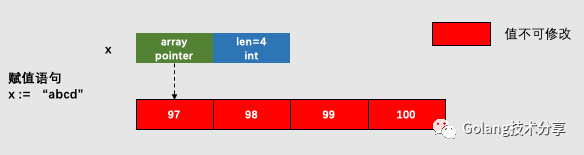
綜上,string與[]byte在底層結(jié)構(gòu)上是非常的相近(后者的底層表達(dá)僅多了一個(gè)cap屬性,因此它們在內(nèi)存布局上是可對(duì)齊的),這也就是為何builtin中內(nèi)置函數(shù)copy會(huì)有一種特殊情況copy(dst []byte, src string) int的原因了。
1// The copy built-in function copies elements from a source slice into a
2// destination slice. (As a special case, it also will copy bytes from a
3// string to a slice of bytes.) The source and destination may overlap. Copy
4// returns the number of elements copied, which will be the minimum of
5// len(src) and len(dst).
6func copy(dst, src []Type) int
7
區(qū)別
對(duì)于[]byte與string而言,兩者之間最大的區(qū)別就是string的值不能改變。這該如何理解呢?下面通過兩個(gè)例子來說明。
對(duì)于[]byte來說,以下操作是可行的:
1b := []byte("Hello Gopher!")
2b [1] = 'T'
string,修改操作是被禁止的:
1s := "Hello Gopher!"
2s[1] = 'T'
而string能支持這樣的操作:
1s := "Hello Gopher!"
2s = "Tello Gopher!"
字符串的值不能被更改,但可以被替換。string在底層都是結(jié)構(gòu)體stringStruct{str: str_point, len: str_len},string結(jié)構(gòu)體的str指針指向的是一個(gè)字符常量的地址, 這個(gè)地址里面的內(nèi)容是不可以被改變的,因?yàn)樗侵蛔x的,但是這個(gè)指針可以指向不同的地址。
那么,以下操作的含義是不同的:
1s := "S1" // 分配存儲(chǔ)"S1"的內(nèi)存空間,s結(jié)構(gòu)體里的str指針指向這塊內(nèi)存
2s = "S2"  // 分配存儲(chǔ)"S2"的內(nèi)存空間,s結(jié)構(gòu)體里的str指針轉(zhuǎn)為指向這塊內(nèi)存
3
4b := []byte{1} // 分配存儲(chǔ)'1'數(shù)組的內(nèi)存空間,b結(jié)構(gòu)體的array指針指向這個(gè)數(shù)組。
5b = []byte{2}  // 將array的內(nèi)容改為'2'
圖解如下
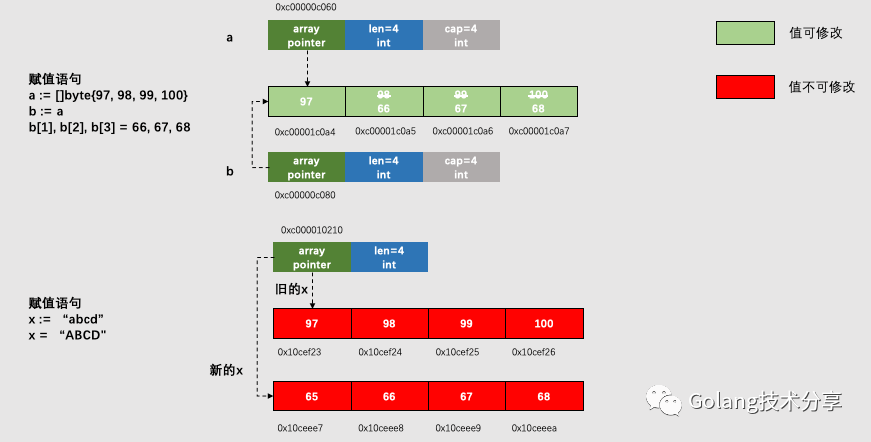
因?yàn)閟tring的指針指向的內(nèi)容是不可以更改的,所以每更改一次字符串,就得重新分配一次內(nèi)存,之前分配的空間還需要gc回收,這是導(dǎo)致string相較于[]byte操作低效的根本原因。
標(biāo)準(zhǔn)轉(zhuǎn)換的實(shí)現(xiàn)細(xì)節(jié)
[]byte(string)的實(shí)現(xiàn)(源碼在src/runtime/string.go中)
 1// The constant is known to the compiler.
 2// There is no fundamental theory behind this number.
 3const tmpStringBufSize = 32
 4
 5type tmpBuf [tmpStringBufSize]byte
 6
 7func stringtoslicebyte(buf *tmpBuf, s string) []byte {
 8    var b []byte
 9    if buf != nil && len(s) <= len(buf) {
10        *buf = tmpBuf{}
11        b = buf[:len(s)]
12    } else {
13        b = rawbyteslice(len(s))
14    }
15    copy(b, s)
16    return b
17}
18
19// rawbyteslice allocates a new byte slice. The byte slice is not zeroed.
20func rawbyteslice(size int) (b []byte) {
21    cap := roundupsize(uintptr(size))
22    p := mallocgc(cap, nil, false)
23    if cap != uintptr(size) {
24        memclrNoHeapPointers(add(p, uintptr(size)), cap-uintptr(size))
25    }
26
27    *(*slice)(unsafe.Pointer(&b)) = slice{p, size, int(cap)}
28    return
29}
這里有兩種情況:s的長度是否大于32。當(dāng)大于32時(shí),go需要調(diào)用mallocgc分配一塊新的內(nèi)存(大小由s決定),這也就回答了上文中的問題2:當(dāng)x的數(shù)據(jù)較大時(shí),標(biāo)準(zhǔn)轉(zhuǎn)換方式會(huì)有一次分配內(nèi)存的操作。
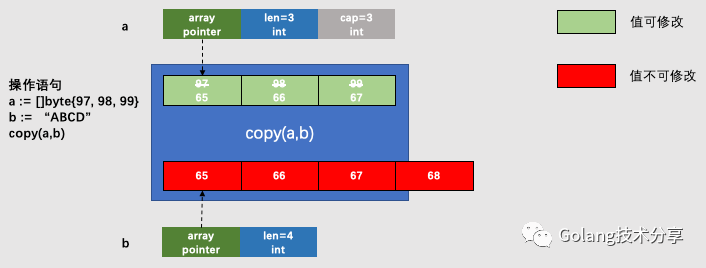
最后通過copy函數(shù)實(shí)現(xiàn)string到[]byte的拷貝,具體實(shí)現(xiàn)在src/runtime/slice.go中的slicestringcopy方法。
 1func slicestringcopy(to []byte, fm string) int {
 2    if len(fm) == 0 || len(to) == 0 {
 3        return 0
 4    }
 5
 6  // copy的長度取決與string和[]byte的長度最小值
 7    n := len(fm)
 8    if len(to) < n {
 9        n = len(to)
10    }
11
12  // 如果開啟了競態(tài)檢測 -race
13    if raceenabled {
14        callerpc := getcallerpc()
15        pc := funcPC(slicestringcopy)
16        racewriterangepc(unsafe.Pointer(&to[0]), uintptr(n), callerpc, pc)
17    }
18  // 如果開啟了memory sanitizer -msan
19    if msanenabled {
20        msanwrite(unsafe.Pointer(&to[0]), uintptr(n))
21    }
22
23  // 該方法將string的底層數(shù)組從頭部復(fù)制n個(gè)到[]byte對(duì)應(yīng)的底層數(shù)組中去(這里就是copy實(shí)現(xiàn)的核心方法,在匯編層面實(shí)現(xiàn) 源文件為memmove_*.s)
24    memmove(unsafe.Pointer(&to[0]), stringStructOf(&fm).str, uintptr(n))
25    return n
26}
copy實(shí)現(xiàn)過程圖解如下
string([]byte)的實(shí)現(xiàn)(源碼也在src/runtime/string.go中)
 1// Buf is a fixed-size buffer for the result,
 2// it is not nil if the result does not escape.
 3func slicebytetostring(buf *tmpBuf, b []byte) (str string) {
 4    l := len(b)
 5    if l == 0 {
 6        // Turns out to be a relatively common case.
 7        // Consider that you want to parse out data between parens in "foo()bar",
 8        // you find the indices and convert the subslice to string.
 9        return ""
10    }
11  // 如果開啟了競態(tài)檢測 -race
12    if raceenabled {
13        racereadrangepc(unsafe.Pointer(&b[0]),
14            uintptr(l),
15            getcallerpc(),
16            funcPC(slicebytetostring))
17    }
18  // 如果開啟了memory sanitizer -msan
19    if msanenabled {
20        msanread(unsafe.Pointer(&b[0]), uintptr(l))
21    }
22    if l == 1 {
23        stringStructOf(&str).str = unsafe.Pointer(&staticbytes[b[0]])
24        stringStructOf(&str).len = 1
25        return
26    }
27
28    var p unsafe.Pointer
29    if buf != nil && len(b) <= len(buf) {
30        p = unsafe.Pointer(buf)
31    } else {
32        p = mallocgc(uintptr(len(b)), nil, false)
33    }
34    stringStructOf(&str).str = p
35    stringStructOf(&str).len = len(b)
36  // 拷貝字節(jié)數(shù)組至字符串
37    memmove(p, (*(*slice)(unsafe.Pointer(&b))).array, uintptr(len(b)))
38    return
39}
40
41// 實(shí)例stringStruct對(duì)象
42func stringStructOf(sp *string) *stringStruct {
43    return (*stringStruct)(unsafe.Pointer(sp))
44}
可見,當(dāng)數(shù)組長度超過32時(shí),同樣需要調(diào)用mallocgc分配一塊新內(nèi)存。最后通過memmove完成拷貝。
強(qiáng)轉(zhuǎn)換的實(shí)現(xiàn)細(xì)節(jié)
1. 萬能的unsafe.Pointer指針
在go中,任何類型的指針*T都可以轉(zhuǎn)換為unsafe.Pointer類型的指針,它可以存儲(chǔ)任何變量的地址。同時(shí),unsafe.Pointer類型的指針也可以轉(zhuǎn)換回普通指針,而且可以不必和之前的類型*T相同。另外,unsafe.Pointer類型還可以轉(zhuǎn)換為uintptr類型,該類型保存了指針?biāo)赶虻刂返臄?shù)值,從而可以使我們對(duì)地址進(jìn)行數(shù)值計(jì)算。以上就是強(qiáng)轉(zhuǎn)換方式的實(shí)現(xiàn)依據(jù)。
而string和slice在reflect包中,對(duì)應(yīng)的結(jié)構(gòu)體是reflect.StringHeader和reflect.SliceHeader,它們是string和slice的運(yùn)行時(shí)表達(dá)。
 1type StringHeader struct {
 2    Data uintptr
 3    Len  int
 4}
 5
 6type SliceHeader struct {
 7    Data uintptr
 8    Len  int
 9    Cap  int
10}
2. 內(nèi)存布局
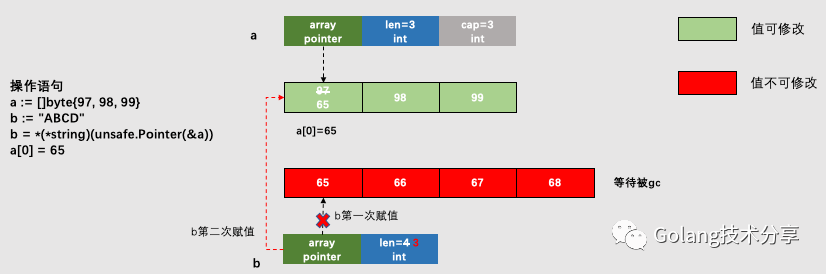
從string和slice的運(yùn)行時(shí)表達(dá)可以看出,除了SilceHeader多了一個(gè)int類型的Cap字段,Date和Len字段是一致的。所以,它們的內(nèi)存布局是可對(duì)齊的,這說明我們就可以直接通過unsafe.Pointer進(jìn)行轉(zhuǎn)換。
[]byte轉(zhuǎn)string圖解
string轉(zhuǎn)[]byte圖解
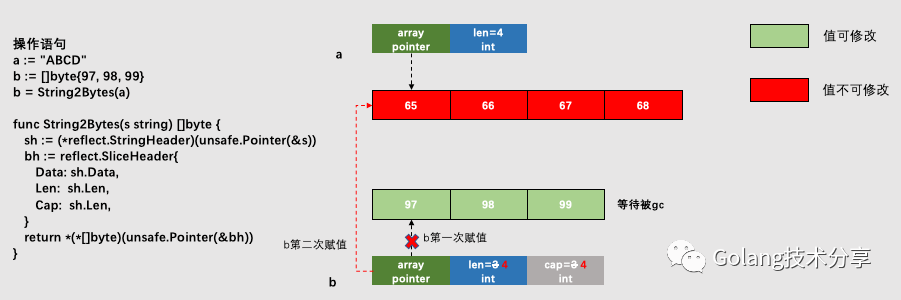
Q&A
Q1.為什么強(qiáng)轉(zhuǎn)換性能會(huì)比標(biāo)準(zhǔn)轉(zhuǎn)換好?
對(duì)于標(biāo)準(zhǔn)轉(zhuǎn)換,無論是從[]byte轉(zhuǎn)string還是string轉(zhuǎn)[]byte都會(huì)涉及底層數(shù)組的拷貝。而強(qiáng)轉(zhuǎn)換是直接替換指針的指向,從而使得string和[]byte指向同一個(gè)底層數(shù)組。這樣,當(dāng)然后者的性能會(huì)更好。
Q2.為什么在上述測試中,當(dāng)x的數(shù)據(jù)較大時(shí),標(biāo)準(zhǔn)轉(zhuǎn)換方式會(huì)有一次分配內(nèi)存的操作,從而導(dǎo)致其性能更差,而強(qiáng)轉(zhuǎn)換方式卻不受影響?
標(biāo)準(zhǔn)轉(zhuǎn)換時(shí),當(dāng)數(shù)據(jù)長度大于32個(gè)字節(jié)時(shí),需要通過mallocgc申請新的內(nèi)存,之后再進(jìn)行數(shù)據(jù)拷貝工作。而強(qiáng)轉(zhuǎn)換只是更改指針指向。所以,當(dāng)轉(zhuǎn)換數(shù)據(jù)較大時(shí),兩者性能差距會(huì)愈加明顯。
Q3.既然強(qiáng)轉(zhuǎn)換方式性能這么好,為什么go語言提供給我們使用的是標(biāo)準(zhǔn)轉(zhuǎn)換方式?
首先,我們需要知道Go是一門類型安全的語言,而安全的代價(jià)就是性能的妥協(xié)。但是,性能的對(duì)比是相對(duì)的,這點(diǎn)性能的妥協(xié)對(duì)于現(xiàn)在的機(jī)器而言微乎其微。另外強(qiáng)轉(zhuǎn)換的方式,會(huì)給我們的程序帶來極大的安全隱患。
如下示例
1a := "hello"
2b := String2Bytes(a)
3b[0] = 'H'
a是string類型,前面我們講到它的值是不可修改的。通過強(qiáng)轉(zhuǎn)換將a的底層數(shù)組賦給b,而b是一個(gè)[]byte類型,它的值是可以修改的,所以這時(shí)對(duì)底層數(shù)組的值進(jìn)行修改,將會(huì)造成嚴(yán)重的錯(cuò)誤(通過defer+recover也不能捕獲)。
1unexpected fault address 0x10b6139
2fatal error: fault
3[signal SIGBUS: bus error code=0x2 addr=0x10b6139 pc=0x1088f2c]
Q4. 為什么string要設(shè)計(jì)為不可修改?
我認(rèn)為有必要思考一下該問題。string不可修改,意味它是只讀屬性,這樣的好處就是:在并發(fā)場景下,我們可以在不加鎖的控制下,多次使用同一字符串,在保證高效共享的情況下而不用擔(dān)心安全問題。
取舍場景
在你不確定安全隱患的條件下,盡量采用標(biāo)準(zhǔn)方式進(jìn)行數(shù)據(jù)轉(zhuǎn)換。
當(dāng)程序?qū)\(yùn)行性能有高要求,同時(shí)滿足對(duì)數(shù)據(jù)僅僅只有讀操作的條件,且存在頻繁轉(zhuǎn)換(例如消息轉(zhuǎn)發(fā)場景),可以使用強(qiáng)轉(zhuǎn)換。

???