
通過pytorch來創(chuàng)建一個(gè)文本分類的Bert模型
「@Author:Runsen」
2018 年,谷歌發(fā)表了一篇題為《Pre-training of deep bidirectional Transformers for Language Understanding》的論文。
在本文中,介紹了一種稱為BERT(帶轉(zhuǎn)換器Transformers的雙向編碼Encoder 器表示)的語言模型,該模型在問答、自然語言推理、分類和通用語言理解評(píng)估或 (GLUE)等任務(wù)中取得了最先進(jìn)的性能.
BERT全稱為Bidirectional Encoder Representation from Transformers[1],是一種用于語言表征的預(yù)訓(xùn)練模型。
它基于谷歌2017年發(fā)布的Transformer架構(gòu),通常的Transformer使用一組編碼器和解碼器網(wǎng)絡(luò),而BERT只需要一個(gè)額外的輸出層,對(duì)預(yù)訓(xùn)練進(jìn)行fine-tune,就可以滿足各種任務(wù),根本沒有必要針對(duì)特定任務(wù)對(duì)模型進(jìn)行修改。
BERT將多個(gè)Transformer編碼器堆疊在一起。Transformer基于著名的多頭注意力(Multi-head Attention)模塊,該模塊在視覺和語言任務(wù)方面都取得了巨大成功。
在本文中,我們將使用 PyTorch來創(chuàng)建一個(gè)文本分類的Bert模型。
筆者介今天紹一個(gè)python庫 --- simpletransformers,可以很好的解決高級(jí)預(yù)訓(xùn)練語言模型使用困難的問題。
simpletransformers使得高級(jí)預(yù)訓(xùn)練模型(BERT、RoBERTa、XLNet、XLM、DistilBERT、ALBERT、CamemBERT、XLM-RoBERTa、FlauBERT)的訓(xùn)練、評(píng)估和預(yù)測(cè)變得簡單,每條只需3行即可初始化模型。
數(shù)據(jù)集來源:https://www.kaggle.com/jrobischon/wikipedia-movie-plots
該數(shù)據(jù)集包含對(duì)來自世界各地的 34,886 部電影的描述。列描述如下:
發(fā)行年份:電影發(fā)行的年份 標(biāo)題:電影標(biāo)題 起源:電影的起源(即美國、寶萊塢、泰米爾等) 劇情:主要演員 類型:電影類型 維基頁面- 從中抓取情節(jié)描述的維基百科頁面的 URL 情節(jié):電影情節(jié)的長篇描述
import numpy as np
import pandas as pd
import os, json, gc, re, random
from tqdm.notebook import tqdm
import torch, transformers, tokenizers
movies_df = pd.read_csv("wiki_movie_plots_deduped.csv")
from sklearn.preprocessing import LabelEncoder

movies_df = movies_df[(movies_df["Origin/Ethnicity"]=="American") | (movies_df["Origin/Ethnicity"]=="British")]
movies_df = movies_df[["Plot", "Genre"]]
drop_indices = movies_df[movies_df["Genre"] == "unknown" ].index
movies_df.drop(drop_indices, inplace=True)

# Combine genres: 1) "sci-fi" with "science fiction" &  2) "romantic comedy" with "romance"
movies_df["Genre"].replace({"sci-fi": "science fiction", "romantic comedy": "romance"}, inplace=True)

# 根據(jù)頻率選擇電影類型
shortlisted_genres = movies_df["Genre"].value_counts().reset_index(name="count").query("count > 200")["index"].tolist()
movies_df = movies_df[movies_df["Genre"].isin(shortlisted_genres)].reset_index(drop=True)

# Shuffle
movies_df = movies_df.sample(frac=1).reset_index(drop=True)

#從不同類型中抽取大致相同數(shù)量的電影情節(jié)樣本(以減少階級(jí)不平衡問題)
movies_df = movies_df.groupby("Genre").head(400).reset_index(drop=True)
label_encoder = LabelEncoder()
movies_df["genre_encoded"] = label_encoder.fit_transform(movies_df["Genre"].tolist())
movies_df = movies_df[["Plot", "Genre", "genre_encoded"]]
movies_df
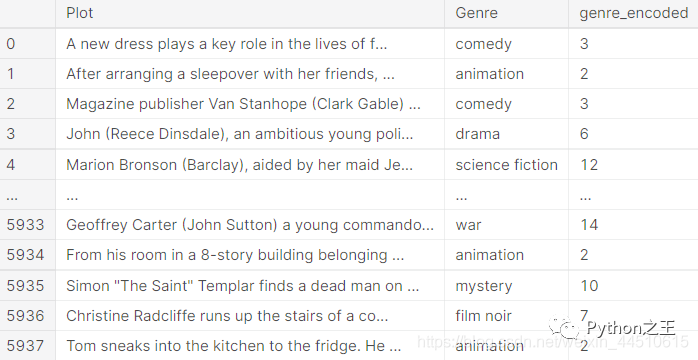
使用 torch 加載 BERT 模型,最簡單的方法是使用 Simple Transformers 庫,以便只需 3 行代碼即可初始化、在給定數(shù)據(jù)集上訓(xùn)練和在給定數(shù)據(jù)集上評(píng)估 Transformer 模型。
from simpletransformers.classification import ClassificationModel

# 模型參數(shù)
model_args = {
    "reprocess_input_data": True,
    "overwrite_output_dir": True,
    "save_model_every_epoch": False,
    "save_eval_checkpoints": False,
    "max_seq_length": 512,
    "train_batch_size": 16,
    "num_train_epochs": 4,
}

# Create a ClassificationModel
model = ClassificationModel('bert', 'bert-base-cased', num_labels=len(shortlisted_genres), args=model_args)
訓(xùn)練模型
train_df, eval_df = train_test_split(movies_df, test_size=0.2, stratify=movies_df["Genre"], random_state=42)

# Train the model
model.train_model(train_df[["Plot", "genre_encoded"]])

# Evaluate the model
result, model_outputs, wrong_predictions = model.eval_model(eval_df[["Plot", "genre_encoded"]])
print(result)

{'mcc': 0.5299659404649717, 'eval_loss': 1.4970421879083518}
CPU times: user 19min 1s, sys: 4.95 s, total: 19min 6s
Wall time: 20min 14s
關(guān)于simpletransformers的官方文檔:https://simpletransformers.ai/docs
Github鏈接:https://github.com/ThilinaRajapakse/simpletransformers