<kbd id="afajh"><form id="afajh"></form></kbd>
<strong id="afajh"><dl id="afajh"></dl></strong>
    <del id="afajh"><form id="afajh"></form></del>
        1. <th id="afajh"><progress id="afajh"></progress></th>
          <b id="afajh"><abbr id="afajh"></abbr></b>
          <th id="afajh"><progress id="afajh"></progress></th>

          告別復制粘貼,Python 實現(xiàn) PDF 轉(zhuǎn)文本

          共 4649字,需瀏覽 10分鐘

           ·

          2021-09-27 17:50

          點擊關注公眾號,干貨及時送達

          機器之心編譯


          對很多人來說,將 PDF 轉(zhuǎn)換為可編輯的文本是個剛需,卻苦于沒有簡單方法。在本文介紹的項目中,來自 K1 Digital 的高級機器學習工程師 Lucas Soares,嘗試使用 OCR(光學字符識別)自動轉(zhuǎn)錄 pdf 幻燈片,轉(zhuǎn)錄效果還不錯。


          傳統(tǒng)的講座通常伴隨著一組 pdf 幻燈片。一般來說,想要對此類講座做筆記,需要從 pdf 復制、粘貼很多內(nèi)容。

          最近,來自 K1 Digital 的高級機器學習工程師 Lucas Soares 一直在嘗試通過使用 OCR(光學字符識別)自動轉(zhuǎn)錄 pdf 幻燈片,以便直接在 markdown 文件中操作它們的內(nèi)容,從而避免手動復制和粘貼 pdf 內(nèi)容,實現(xiàn)這一過程的自動化。


          左為項目作者 Lucas Soares。

          項目地址:https://github.com/EnkrateiaLucca/ocr_for_transcribing_pdf_slides

          為什么不使用傳統(tǒng)的 pdf 轉(zhuǎn)文本工具呢?

          Lucas Soares 發(fā)現(xiàn)傳統(tǒng)工具往往會帶來更多的問題,需要花時間解決。他曾經(jīng)嘗試使用傳統(tǒng)的 Python 軟件包,但是遇到了很多問題(例如必須使用復雜的正則表達式模式解析最終輸出等),因此決定嘗試使用目標檢測和 OCR 來解決。

          基本過程可分為以下步驟:

          • 將 pdf 轉(zhuǎn)換為圖片;

          • 檢測和識別圖像中的文本;

          • 展示示例輸出。


          基于深度學習的 OCR 將 pdf 轉(zhuǎn)錄為文本

          將 pdf 轉(zhuǎn)換為圖像

          Soares 使用的 pdf 幻燈片來自于 David Silver 的增強學習(參見以下 pdf 幻燈片地址)。使用「pdf2image」包將每張幻燈片轉(zhuǎn)換為 png 圖像格式。


          pdf 幻燈片示例。地址:https://www.davidsilver.uk/wp-content/uploads/2020/03/intro_RL.pdf

          代碼如下:
          from pdf2image import convert_from_path
          from pdf2image.exceptions import (
           PDFInfoNotInstalledError,
           PDFPageCountError,
           PDFSyntaxError
          )

          pdf_path = "path/to/file/intro_RL_Lecture1.pdf"
          images = convert_from_path(pdf_path)
          for i, image in enumerate(images):
              fname = "image" + str(i) + ".png"
              image.save(fname, "PNG")
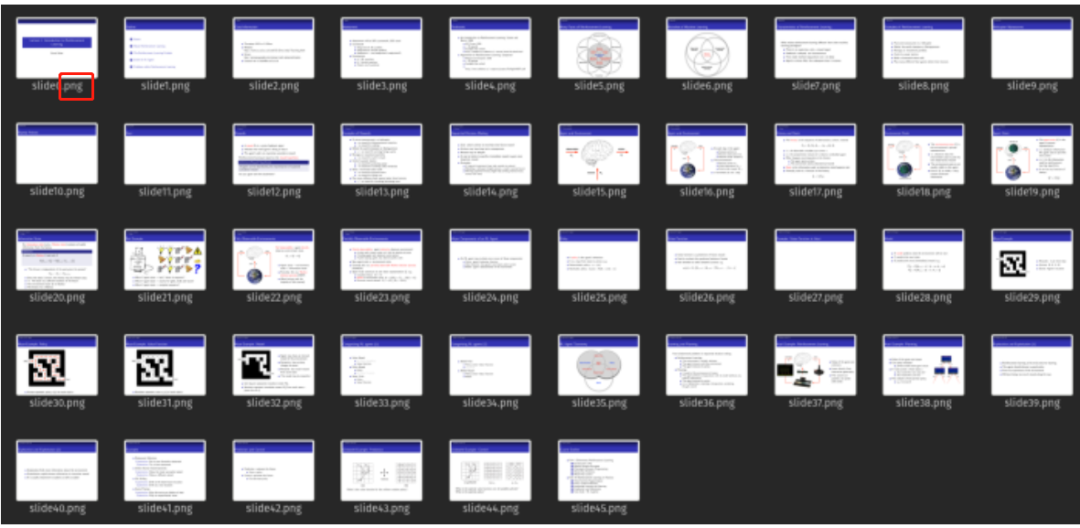

          經(jīng)過處理后,所有的 pdf 幻燈片都轉(zhuǎn)換成 png 格式的圖像:


          檢測和識別圖像中的文本

          為了檢測和識別 png 圖像中的文本,Soares 使用 ocr.pytorch 庫中的文本檢測器。按照說明下載模型并將模型保存在 checkpoints 文件夾中。

          ocr.pytorch 庫地址:https://github.com/courao/ocr.pytorch

          代碼如下:
          # adapted from this source: https://github.com/courao/ocr.pytorch
          %load_ext autoreload
          %autoreload 2
          import os
          from ocr import ocr
          import time
          import shutil
          import numpy as np
          import pathlib
          from PIL import Image
          from glob import glob
          import matplotlib.pyplot as plt
          import seaborn as sns
          sns.set()
          import pytesseract

          def single_pic_proc(image_file):
              image = np.array(Image.open(image_file).convert('RGB'))
              result, image_framed = ocr(image)
              return result,image_framed

          image_files = glob('./input_images/*.*')
          result_dir = './output_images_with_boxes/'

          # If the output folder exists we will remove it and redo it.
          if os.path.exists(result_dir):
              shutil.rmtree(result_dir)
          os.mkdir(result_dir)

          for image_file in sorted(image_files):
              result, image_framed = single_pic_proc(image_file) # detecting and recognizing the text
              filename = pathlib.Path(image_file).name
              output_file = os.path.join(result_dir, image_file.split('/')[-1])
              txt_file = os.path.join(result_dir, image_file.split('/')[-1].split('.')[0]+'.txt')
              txt_f = open(txt_file, 'w')
              Image.fromarray(image_framed).save(output_file)
              for key in result:
                  txt_f.write(result[key][1]+'\n')
              txt_f.close()


          設置輸入和輸出文件夾,接著遍歷所有輸入圖像(轉(zhuǎn)換后的 pdf 幻燈片),然后通過 single_pic_proc() 函數(shù)運行 OCR 模塊中的檢測和識別模型,最后將輸出保存到輸出文件夾。

          其中檢測繼承(inherit)了 Pytorch CTPN 模型,識別繼承了 Pytorch CRNN 模型,兩者都存在于 OCR 模塊中。

          示例輸出

          代碼如下:
          import cv2 as cv

          output_dir = pathlib.Path("./output_images_with_boxes")

          # image = cv.imread(str(np.random.choice(list(output_dir.iterdir()),1)[0]))
          image = cv.imread(f"{output_dir}/image7.png")
          size_reshaped = (int(image.shape[1]),int(image.shape[0]))
          image = cv.resize(image, size_reshaped)
          cv.imshow("image", image)
          cv.waitKey(0)
          cv.destroyAllWindows()
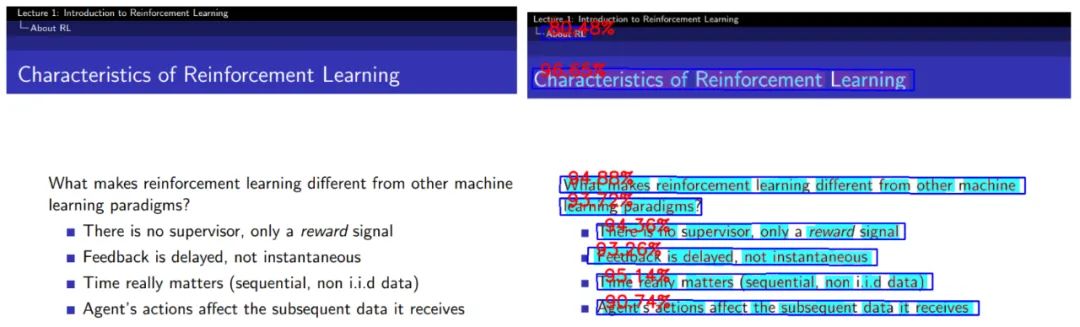

          下圖左為原始 pdf 幻燈片,圖右為轉(zhuǎn)錄后的輸出文本,轉(zhuǎn)錄后的準確率非常高。


          文本識別輸出如下:
          filename = f"{output_dir}/image7.txt"
          with open(filename, "r"as text:
              for line in text.readlines():
                  print(line.strip("\n"))


          通過上述方法,最終你可以得到一個非常強大的工具來轉(zhuǎn)錄各種文檔,從檢測和識別手寫筆記到檢測和識別照片中的隨機文本。擁有自己的 OCR 工具來處理一些文本內(nèi)容,這比依賴外部軟件來轉(zhuǎn)錄文檔要好的多。

          原文鏈接:https://towardsdatascience.com/faster-notes-with-python-and-deep-learning-b713bbb3c186


          推薦閱讀

          (點擊標題可跳轉(zhuǎn)閱讀)

          李宏毅《機器學習》視頻教程 PPT

          一個算法工程師復現(xiàn)算法的踩坑總結(jié)

          【機器學習】算法黑話大賞,我直呼好家伙!

          【Python工具箱】自動可視化任何數(shù)據(jù)集!!!

          Pycharm那些隱藏的實用小技巧,太強了

          老鐵,三連支持一下,好嗎?↓↓↓

          瀏覽 63
          點贊
          評論
          收藏
          分享

          手機掃一掃分享

          分享
          舉報
          評論
          圖片
          表情
          推薦
          點贊
          評論
          收藏
          分享

          手機掃一掃分享

          分享
          舉報
          <kbd id="afajh"><form id="afajh"></form></kbd>
          <strong id="afajh"><dl id="afajh"></dl></strong>
            <del id="afajh"><form id="afajh"></form></del>
                1. <th id="afajh"><progress id="afajh"></progress></th>
                  <b id="afajh"><abbr id="afajh"></abbr></b>
                  <th id="afajh"><progress id="afajh"></progress></th>
                  特级西西人体444.444人体聚色 | 亚洲欧洲在线无码 | 乱伦视频图片 | 波多野结衣乱码无码视频 | 日本猛少妇高潮喷水XXX96 |