
數(shù)據(jù)分析——特征工程之特征關(guān)聯(lián)
一、特征的相關(guān)矩陣
特征的相關(guān)矩陣
目標(biāo)的相關(guān)矩陣
畫出最相關(guān)的特征之間的關(guān)系
import?pandas?as?pd
import?seaborn?as?sns
import?matplotlib.pyplot?as?plt

df?=?pd.read_csv('./data/train.csv')
corr_mat?=?df.corr()
f,?ax?=?plt.subplots(figsize=(12,?9))
sns.heatmap(corr_mat,?vmax=.8,?square=True,?ax=ax)
plt.show()
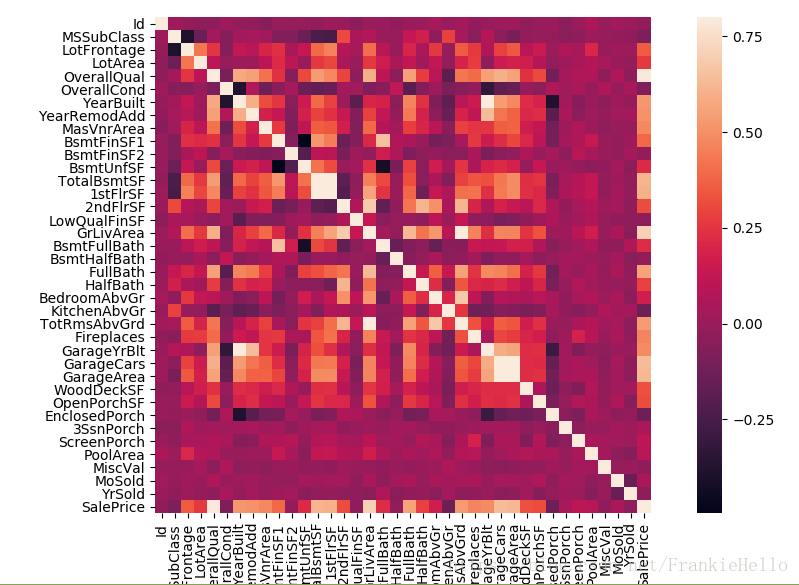
通過這個(gè)熱力圖,可以很直觀的對(duì)各個(gè)特征之間的關(guān)系一目了然。另外,從圖中可以看出TotalBsmtSF和1stFlrSF變量之間的相關(guān)性很明顯,這就說明了如果同時(shí)使用這兩個(gè)特征就會(huì)導(dǎo)致信息的冗余性,所以要盡量避免使用冗余的特征。
其中看一下df.corr()函數(shù)的源碼:
?def?corr(self,?method='pearson',?min_periods=1):
????????"""
????????Compute?pairwise?correlation?of?columns,?excluding?NA/null?values

????????Parameters
????????----------
????????method?:?{'pearson',?'kendall',?'spearman'}
????????????*?pearson?:?standard?correlation?coefficient
????????????*?kendall?:?Kendall?Tau?correlation?coefficient
????????????*?spearman?:?Spearman?rank?correlation
????????min_periods?:?int,?optional
????????????Minimum?number?of?observations?required?per?pair?of?columns
????????????to?have?a?valid?result.?Currently?only?available?for?pearson
????????????and?spearman?correlation

????????Returns
????????-------
????????y?:?DataFrame
????????"""
默認(rèn)method參數(shù)是pearson,下面介紹下這三種相關(guān)系數(shù):
1、Pearson correlation coefficient(皮爾遜相關(guān)系數(shù))
皮爾遜相關(guān)系數(shù)用于度量?jī)蓚€(gè)變量X和Y之間的相關(guān)性(線性相關(guān)),它的值介于-1和1之間。
兩個(gè)變量之間的皮爾遜相關(guān)系數(shù)定義為兩個(gè)變量之間的協(xié)方差和標(biāo)準(zhǔn)差的商。
2、Kendall correlation coefficient(肯德爾相關(guān)性系數(shù))
它所計(jì)算的對(duì)象是分類變量。
3、Spearman correlation coefficient(斯皮爾曼相關(guān)性系數(shù))
它是衡量?jī)蓚€(gè)變量的依賴性的非參數(shù)指標(biāo)。它利用單調(diào)方程評(píng)價(jià)兩個(gè)統(tǒng)計(jì)變量的相關(guān)性,如果數(shù)據(jù)中沒有重復(fù)值,并且兩個(gè)變量完全單調(diào)相關(guān)時(shí),斯皮爾曼相關(guān)系數(shù)則為+1或者-1。
二、目標(biāo)的相關(guān)矩陣
找到與目標(biāo)值相關(guān)性最大的幾個(gè)特征,而這幾個(gè)特征之間的相關(guān)性要低。
?k?=?10
cols?=?corr_mat.nlargest(k,?'SalePrice')['SalePrice'].index
cm?=?np.corrcoef(df[cols].values.T)
sns.heatmap(cm,?annot=True,?square=True,?yticklabels=cols.values,?xticklabels=cols.values)
plt.show()
通過以上代碼得到與目標(biāo)值相關(guān)性最大的前10個(gè)值,做出熱力圖。
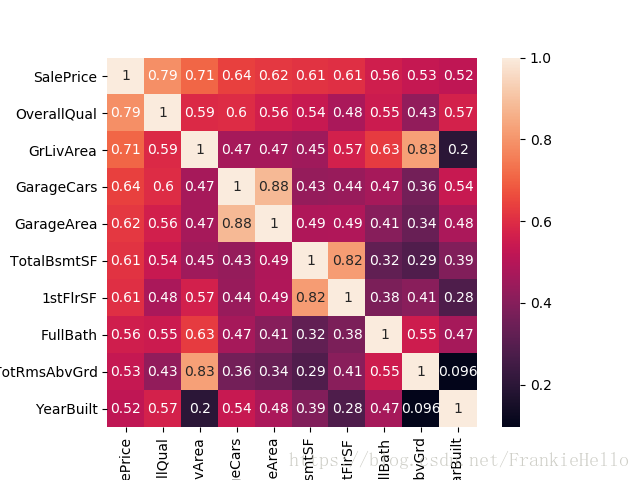
從圖中可以很明顯地看出OverallQual、GrLivArea等特征與SalePrice目標(biāo)值之間有很大的關(guān)聯(lián)。
三、最相關(guān)的特征之間的關(guān)系圖
cols?=?['SalePrice',?'OverallQual',?'GrLivArea',?'GarageCars',?'TotalBsmtSF',?'FullBath',?'YearBuilt']
sns.pairplot(df[cols],?height?=?2.5)
plt.show()
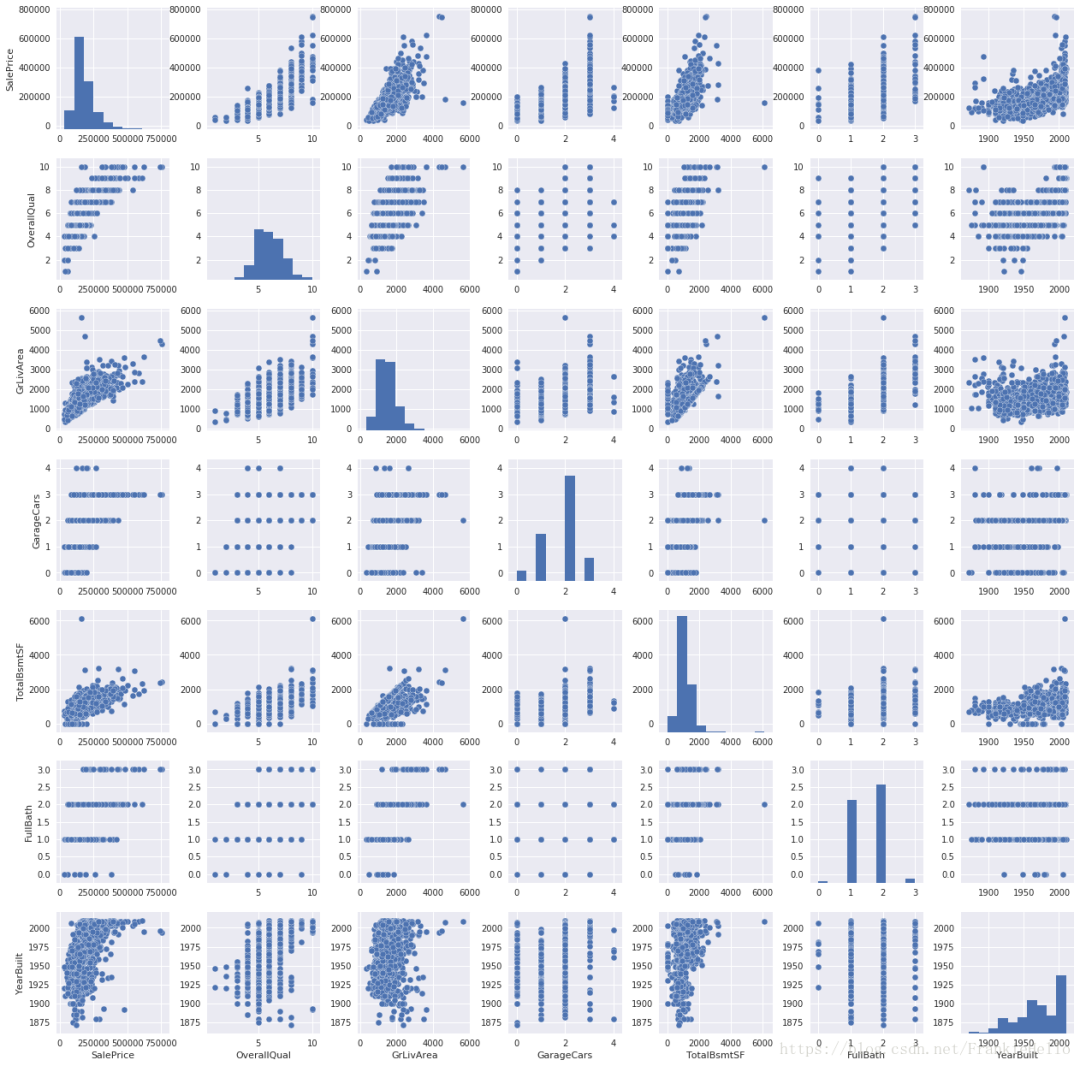
盡管我們已經(jīng)知道了這些特征之間的一些關(guān)系,但是通過這個(gè)圖可以給與一個(gè)更充分的理由。
《數(shù)據(jù)科學(xué)與人工智能》公眾號(hào)推薦朋友們學(xué)習(xí)和使用Python語言,需要加入Python語言群的,請(qǐng)掃碼加我個(gè)人微信,備注【姓名-Python群】,我誠邀你入群,大家學(xué)習(xí)和分享。
? ? 關(guān)于Python語言,有任何問題或者想法,請(qǐng)留言或者加群討論。